

This 23 October, OpenAI switched off 11 API models and 6 fine-tuned models. If you had trained one of them on your own data, built a product on it and sold that product to customers, it stopped working that day. Nobody asked you. Fine-tuning itself will be turned off in due course.
AI needs to be ownable. Today it partly isn’t.
We’ve been here twice before. Every step of the information age ran the same way. Someone built it from what people had written. Someone tried to close it. The open version won, and the wealth came from what everyone built on top.
Books let everyone know
In 1454, Gutenberg printed somewhere between 160 and 185 Bibles. Some cost as much as 30 florins, three years’ wages for a clerk. A book was something a monastery owned, or a prince. Knowledge was something you were told.
Seven decades later, Luther’s New Testament was priced at just one guilder (two months’ salary for a schoolmaster) per copy in the first run: 3,000 to 5,000 copies. By 1534, more than 200,000 copies had been sold. People read the text themselves in their own language. They argued about it, wrote back, printed their answers. The copy was theirs and so was what they did with it.
Soon wealth followed to those European cities where printing was introduced in the 1400s. From 1500 to 1600, the printing cities grew 60% faster than similar cities without a press. They had no advantage before the press arrived.
Someone tried to close it
Someone tried to close down printing: the English Crown chartered the Stationers’ Company on 4 May 1557 to control printing in order to check the spread of the Protestant Reformation. Only members could print. The Company’s register of texts by their owners is where the word “copyright” originates.
It slowed print, it never stopped it. In 1695, Parliament let the licensing system lapse, and the monopoly ended with it. 15 years later the Statute of Anne, “An Act for the Encouragement of Learning”, gave copyright to authors instead of printers, for 14 years. Then the text belonged to everyone. Until then, to whoever wrote it.
The internet distributed it
Gopher was the first popular way to browse online information in the early 1990s. Until the spring of 1994 it carried more traffic than the Web.
In February 1993, the University of Minnesota announced license fees for its Gopher server software. Users worried that fees would follow for every other Gopher implementation too. Two months later, on 30 April 1993, CERN released the Web software, with all intellectual property rights relinquished by CERN for the Web software. Anyone could build a server, a browser, a business.
Gopher development stalled shortly thereafter. The Web became the internet.
Nobody got rich owning HTTP. People got rich building on it: search, shops, marketplaces, media, a whole valley of companies. In OECD countries from 1996 to 2007, every 10 percentage points of additional broadband penetration raised annual per capita growth by 0.9 to 1.5 percentage points.
AI makes it usable
AI is built from the same pool. Of 47 large language models published from 2019 to October 2023, at least 64% were trained on Common Crawl, a copy of the open web (Mozilla). Everything people wrote, read and published since the first web server, turned into something that can act on it.
Print let everyone know. The internet let everyone reach it. AI lets everyone use it: write the contract, check the claim, run the process. That’s the biggest step of the three, and the one with the most wealth on top.
And again somebody tries to close it
OpenAI’s shutdown is one case. The license of Liquid AI ends all commercial rights after $10M in revenue. As with Gopher’s license fee, the ceiling for what you can build is written into the license. Most frontier models get rented by the token and the provider can change the price as he sees fit.
That’s Gopher’s license fee. That’s the Stationers’ charter. A closed base, and permission for everything built on top.
The mechanism is already running
Open models hit the frontier about 12 months after their closed counterparts (Epoch AI, November 2024). The time lag has now shrunk to 4 months (Epoch AI, May 2026), down by two thirds within 18 months.
And you can run them on your own hardware. A model on a single consumer graphics card today matches what the frontier did 6 to 12 months earlier (Epoch AI).
What owning AI means
What I mean by ownership in Own 2026 is that the open model is owned by everyone. The application on top of the model is owned by the individual who developed it.
A contract review tool for a law firm, a reconciliation tool for a bank, an intake tool for a hospital: these are where the real businesses are. Build a platform on top of an open model, specialize it and earn money with it and your customers, and the value you create stays with you instead of being concentrated in the hands of the owner of the model.
As with the book, as with the protocol.
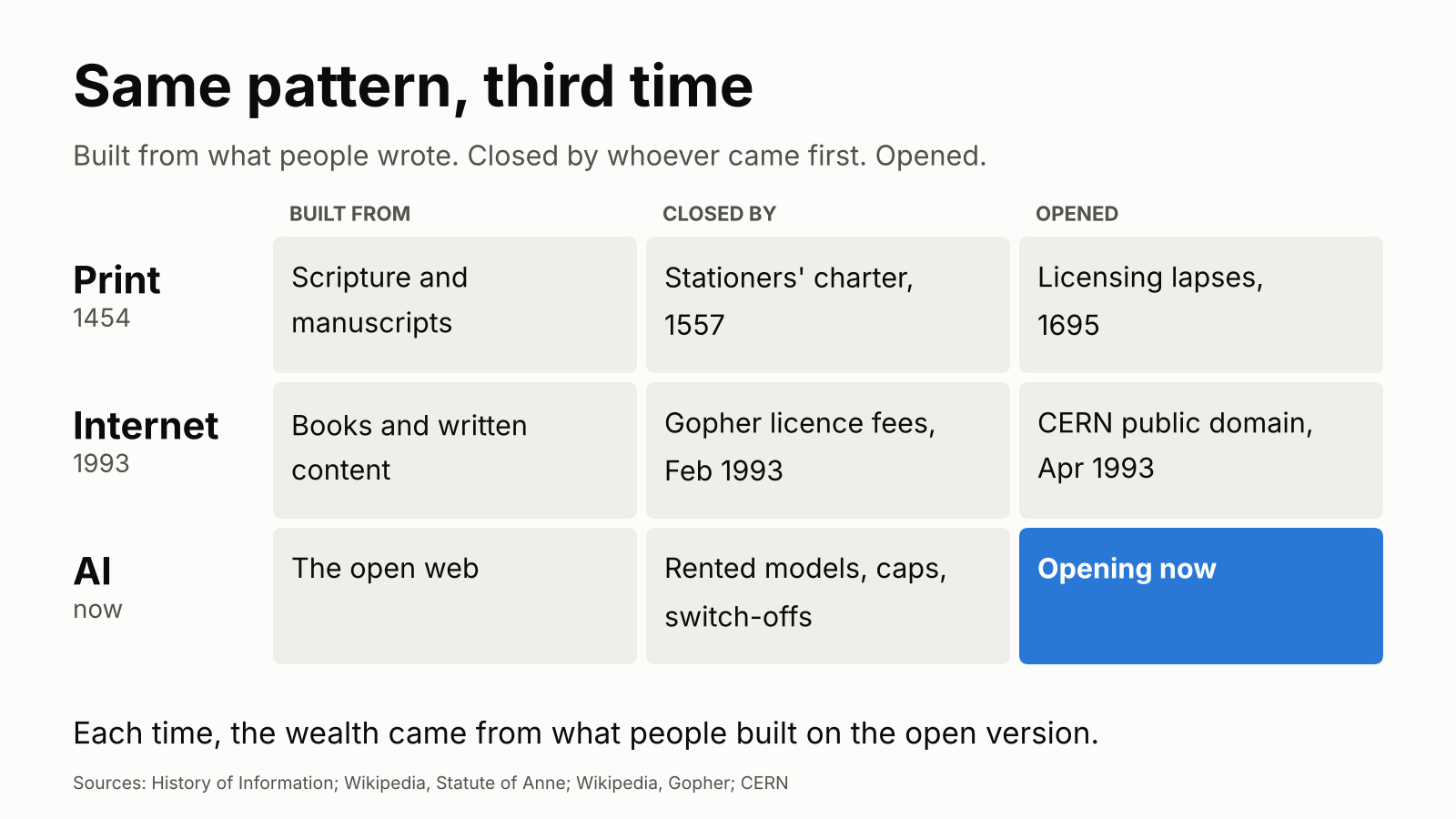
Same pattern, third time
Built from what people wrote. Closed by whoever got there first. Opened, because the open version is good enough and anyone can build on it.
It’s taking shape now. Open models a few months behind, running on your own hardware, while the closed ones get switched off, repriced and capped. Every step makes building on a closed model a worse deal.
It’s not a question of if. Print needed 138 years from the Stationers’ charter to the end of licensing. The Web needed two months from Gopher’s fee to CERN’s release. AI is somewhere in between, and moving fast.
And it’s for the greater good. The wealth goes to whoever builds on top, not to whoever holds the base. That’s how the printing cities grew. That’s how the web economy grew.
Gopher started first. The Web won.